
Eye Conditions
What is 20/20 vision?
Questions about your own eyes? Speak to Ms Pearsall's team — free, no obligation. UK private patients.
If you have ever had an eye test, you have probably heard the phrase '20/20 vision'. It is often described as 'perfect' eyesight, but that is not quite accurate. Twenty-twenty is a measurement of visual acuity — how clearly you can see details at a standard distance — and it is only one part of overall vision quality.
What the numbers mean
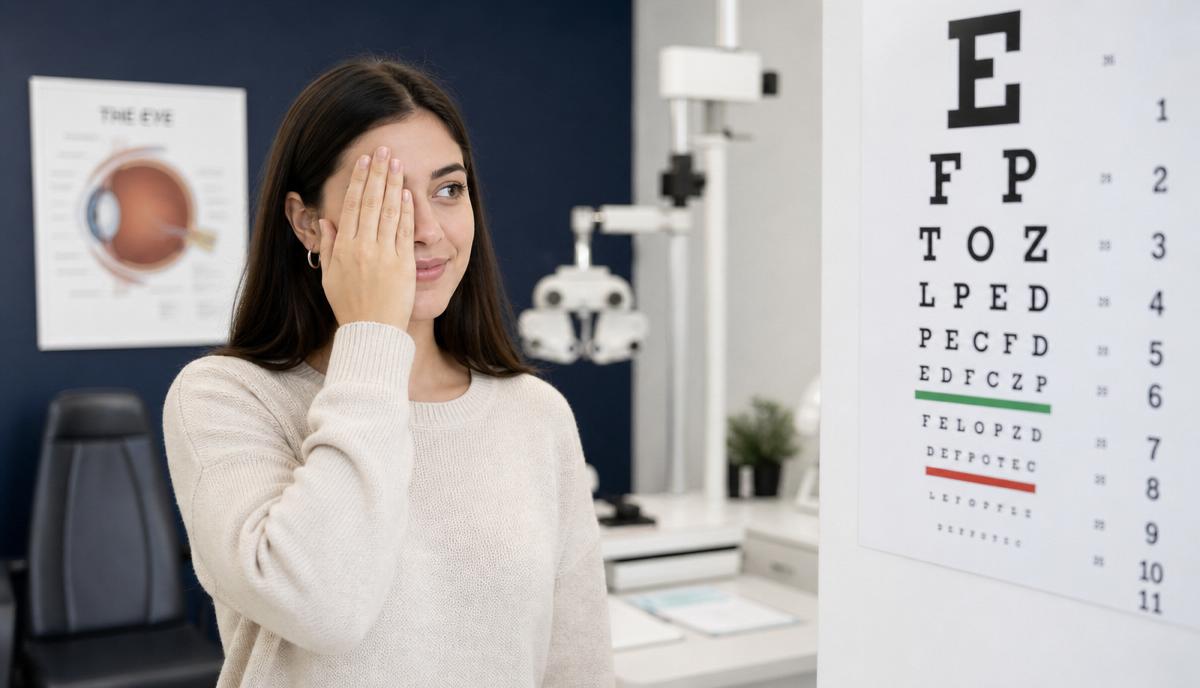
The Snellen chart, the familiar chart with rows of shrinking letters, is the basis of the 20/20 measurement. The first number refers to the distance you are standing from the chart, usually 20 feet. The second number refers to the distance at which a person with normal sight could read the same line.
So if you have 20/20 vision, you can see at 20 feet what a person with normal vision can see at 20 feet. If you have 20/40 vision, you can see at 20 feet what someone with normal vision can see at 40 feet. In other words, your vision is half as sharp as the standard.
Is 20/20 the best possible vision?
No. Many people, especially younger patients, can see better than 20/20. It is common to achieve 20/15 or even 20/10 after laser eye surgery or with the right glasses. These numbers mean you can see at 20 feet what a person with normal vision would need to be at 15 or 10 feet to see.
20/20 is simply a benchmark. It is the level of clarity generally accepted as normal, not a ceiling.
Does 20/20 mean perfect vision?
Not necessarily. Visual acuity is only one measure of how well your eyes work. You can have 20/20 sight on a chart and still struggle with:
- Contrast sensitivity — telling objects apart from their background
- Colour vision
- Peripheral vision
- Depth perception
- Focusing speed and comfort, especially at a computer
- Night vision and glare recovery
This is why a comprehensive eye examination includes much more than reading a Snellen chart.
How is 20/20 measured?
During a standard eye test, you sit or stand at a fixed distance from a chart and read progressively smaller letters. The smallest line you can read reliably gives your visual acuity score. In the UK, the equivalent notation is often written as 6/6, because testing is done at six metres rather than 20 feet. 6/6 and 20/20 mean the same thing.
Can you have 20/20 vision with glasses or contact lenses?
Yes. Most people who wear glasses or contact lenses can be corrected to 20/20 or better if their eyes are healthy. The prescription simply bends light so that it focuses clearly on the retina. Laser eye surgery achieves the same optical result by reshaping the cornea, often allowing people to achieve 20/20 or better without glasses.
What if your vision is worse than 20/20?
Reduced vision can be caused by many things: short-sight, long-sight, astigmatism, cataracts, corneal disease, macular degeneration, glaucoma or problems with the optic nerve. The important point is that a low score on the chart is a symptom, not a diagnosis. Finding the cause is what matters.
Next steps
If you are curious about your vision or want to know whether you could achieve 20/20 without glasses, book a comprehensive eye examination. We can measure your visual acuity, check the health of your eyes, and discuss the options that best match your lifestyle.
Explore more on Eye Conditions
Related reading
Medical ophthalmology — consultant diagnosis & second opinions- Can you leave cataracts untreated?
What happens if you do nothing about cataracts, and when delaying surgery stops being a good idea.
- What causes blurred vision?
The common and serious causes of blurred vision, and when to seek an urgent eye examination.
- Presbyopia in your 40s: reading glasses aren't your only option
How modern trifocal lenses can restore near, intermediate and distance vision in a single procedure.
- My distance vision is good but I need glasses for reading — what should I do?
If your distance sight is still clear but reading is becoming a struggle, presbyopia is the most likely cause. Ms Tahmina Pearsall explains what to do next.
Keep reading
Ready to discuss your options?
Book a private consultation with Ms Tahmina Pearsall, or call our secretary directly — mention this article and we'll pull up the treatment details for you.
Prefer to read first? 10 questions to ask your cataract surgeon
Newsletter
Stay informed about your eye health
Get expert articles, clinic news and treatment updates from Dr Tahmina Pearsall — straight to your inbox.