
Lens Replacement
Is lens replacement or cataract surgery good for playing darts?
Think you may need cataract surgery? Ms Pearsall can review your eyes privately in the UK — free, no-obligation call.
Considering cataract treatment? Speak to consultant Ms Pearsall directly.
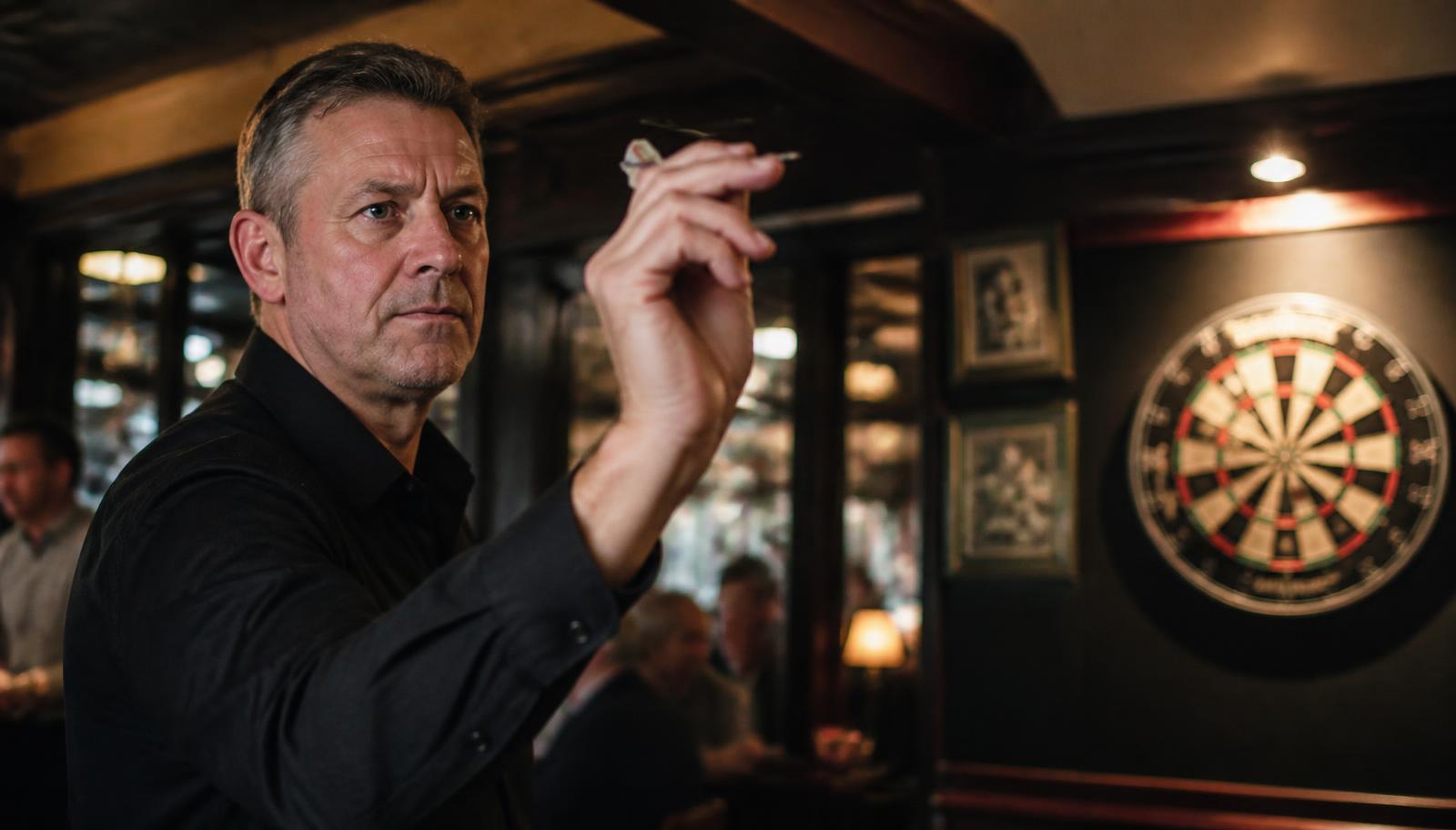
Book a cataract consultationDarts looks like a game of hands, but it is really a game of eyes. From the oche you are asking your vision to resolve a treble bed a little over two metres away, hold a steady focus while the arm moves, switch to the scoreboard, and then look down at the flights in your hand — often in a room with warm, uneven pub lighting and a brightly lit board surrounded by shadow.
That combination of intermediate detail, quick focus changes and awkward lighting is exactly what an ageing natural lens struggles with. If you have cataracts developing, or you have simply reached the age where reading glasses have crept in, lens replacement or cataract surgery can make a real difference to your game. This guide explains what changes, which lens suits darts best, and when you can safely get back to the board.
The same operation, two different reasons
Cataract surgery and lens replacement surgery are the same procedure: the eye's natural lens is removed and replaced with an artificial intraocular lens. Cataract surgery is done when that natural lens has clouded. Refractive lens exchange is done on a clear lens purely to correct vision and reduce dependence on glasses. Recovery and lens options are identical, so the important question for a darts player is which lens to choose.
Why darts is an intermediate-vision sport
The distance from the oche to the board is 2.37 metres. That is not true distance vision and it is not reading vision — it sits squarely in the intermediate zone, the very range that presbyopia and early cataract erode first. Varifocal glasses are notoriously awkward for darts because the intermediate corridor is narrow and you are looking through the lens at a slightly raised angle while your head stays still.
This is why so many players end up with a dedicated pair of single-vision 'darts glasses' or with heads tilted at odd angles. A well-chosen intraocular lens can remove that problem entirely.
The three distances a darts player needs
- Intermediate (the board) — resolving the wires, the treble and double beds, and the edge of a dart already in the board.
- Distance (the scoreboard or screen) — reading the score across the room without squinting.
- Near (the hand) — checking flights and stems, and using a phone or scoring app between legs.
Add dim, warm, uneven lighting and you have a demanding visual task. Contrast sensitivity matters as much as sharpness, because a black wire against a black segment is a low-contrast target.
Which lens is best for darts?
- EDOF (extended depth of focus) lenses are often the standout choice for darts. They stretch focus through the intermediate range, which is exactly where the board sits, while keeping contrast closer to a monofocal lens and producing fewer halos than a trifocal. Most EDOF patients see the board and the scoreboard clearly and need only thin readers for very small print.
- Trifocal lenses add a dedicated intermediate focal point plus a strong near point, giving the best chance of being completely glasses-free — board, scoreboard, flights and phone. The trade-off is a modest reduction in contrast and more chance of halos around lights, which can matter in a dim room with a bright board light.
- Monofocal lenses set for distance give the crispest, highest-contrast vision, and most players still see the board very well at 2.37 metres. You will need readers for close work. A monofocal lens can also be targeted slightly short of infinity to favour the intermediate range, which some surgeons will consider for a keen player.
- Toric lenses correct astigmatism. Uncorrected astigmatism blurs and doubles the wires on the board, so if you have it, a toric lens is often the single biggest upgrade to your view of the treble twenty.
Lighting, halos and the pub environment
A darts board is usually lit brightly while the rest of the room is dim. That high-contrast, low-ambient-light setting is the hardest environment for multifocal lenses, because halos and starbursts are most noticeable when a bright source sits in a dark surround. Most players adapt within three to six months, but if you play in leagues several nights a week and drive home afterwards on unlit roads, an EDOF or monofocal lens is often the more comfortable long-term choice.
Modern board lighting systems that surround the board and remove shadow help considerably, and are worth suggesting at your club if the lighting is poor.
What improves most after surgery
Players with cataracts usually report three changes. The wires and segment edges look sharper, so aiming feels more confident. Colours on the board look brighter and more separated, which makes the doubles and trebles easier to pick out. And glare from the board light is much reduced, because the clouded lens that was scattering that light has gone.
Players without cataracts who have lens replacement mainly notice the freedom: no more tilting the head to find the corridor in a varifocal, no more swapping glasses to read the scoreboard, and no more misted lenses in a warm room.
Getting back to the oche after surgery
Surgery is a day case under local anaesthetic and takes around 15–20 minutes per eye. Vision is generally usable within 24–48 hours and sharpens over the following weeks. Darts is a low-impact sport, which helps, but the throwing action involves a firm arm movement and long periods of concentration.
As a general guide, and always subject to your surgeon's advice: rest the eye completely for the first few days. Light practice at home is usually reasonable from about one to two weeks. League matches and long evening sessions are best left until three to four weeks, by which time the eye has settled and any early halos have started to fade. Avoid smoky or dusty rooms while you are still using drops, and never rub the eye.
If you have surgery on both eyes, they are usually done one to four weeks apart, and many players prefer to wait until the second eye has settled before returning to competitive play.
Who is a good candidate?
The best outcomes come from eyes that are healthy apart from the lens: a good macula, a healthy cornea, a stable tear film and no significant glaucoma. If you have macular degeneration, diabetic retinopathy, marked dry eye or previous laser refractive surgery, a monofocal lens is usually the safer recommendation and premium lenses may not be advisable.
Realistic expectations matter. The goal is comfortable, reliable vision for the darts you actually play, not a guarantee of a higher average.
Talk about your darts at the consultation
Tell your surgeon how often you play, how the venue is lit, whether you use a scoring app, and how much you drive at night. Those details point clearly towards EDOF, trifocal or monofocal, and they matter more than any lens brand name.
Ms Tahmina Pearsall has performed over 50,000 intraocular procedures and offers the full range of monofocal, toric, EDOF and trifocal lenses, carrying out the measurements, the surgery and the aftercare personally.
Next steps
Book a consultation to find out which lens best suits your eyes and your game. You will receive a full assessment including corneal mapping and macular OCT, an honest recommendation, and a clear written quote with no pressure to proceed.
Frequently asked questions
- Will cataract surgery help me see the dartboard more clearly?
- Usually, yes. Removing a cataract restores contrast and colour, so the wires, segment edges and treble beds look sharper and glare from the board light is much reduced.
- Which lens is best for darts?
- EDOF lenses are often ideal because the board sits at 2.37 metres, in the intermediate range they cover best, with good contrast and few halos. Trifocal lenses give the best glasses-free result overall, and monofocal lenses give the crispest contrast in dim rooms but need readers for close work.
- How soon after cataract surgery can I play darts?
- Light practice at home is usually reasonable from around one to two weeks, and league matches from about three to four weeks, provided healing is uncomplicated. Follow the advice given at your post-operative checks.
- Are varifocal glasses bad for darts?
- Many players find them awkward, because the intermediate corridor is narrow and you must hold your head at a particular angle. An intraocular lens sits inside the eye, so there is no corridor to find and no frame to look around.
- Will halos around the board light be a problem?
- Halos are most common with multifocal and trifocal lenses and are most noticeable when a bright board light sits in a dim room. They usually fade over three to six months. If you play in poorly lit venues several nights a week, discuss an EDOF or monofocal lens instead.
- Can astigmatism affect my darts?
- Yes. Uncorrected astigmatism blurs and can double the wires on the board. A toric intraocular lens corrects it at the time of surgery and often produces the most noticeable improvement for players.
Explore more on Lens Replacement
Related reading
- Will lens replacement surgery help my golf?
How refractive lens exchange can sharpen your view of the ball, the fairway and the flag — and what golfers should know before booking surgery.
- How good is multifocal lens replacement surgery for golf?
A golfer's guide to multifocal and trifocal lens replacement surgery — how it performs on the fairway, green and in the clubhouse, and who it suits best.
- How good is multifocal lens replacement surgery for snooker?
A snooker player's guide to multifocal lens replacement — how it affects sight down the table, cue-ball focus, lighting and the scorecard, and whether it is the right choice.
- Is lens replacement or cataract surgery good for fishing?
An angler's guide to lens replacement and cataract surgery — spotting the float and the fly, glare off the water, tying knots at dusk, and which lens suits fishing best.
Keep reading
Greater London
Book a consultation in London
Ms Tahmina Pearsall FRCOphth sees London patients for lens replacement and private cataract surgery, with fixed written quotes from £2,750 per eye and 12 months of consultant aftercare included.
Also seeing patients in
Ready to discuss your options?
Book a private consultation with Ms Tahmina Pearsall, or call our secretary directly — mention this article and we'll pull up the treatment details for you.
Prefer to read first? 10 questions to ask your cataract surgeon
Newsletter
Stay informed about your eye health
Get expert articles, clinic news and treatment updates from Dr Tahmina Pearsall — straight to your inbox.