
Eye Conditions
Halos around lights at night: what they mean
Questions about your own eyes? Speak to Ms Pearsall's team — free, no obligation.
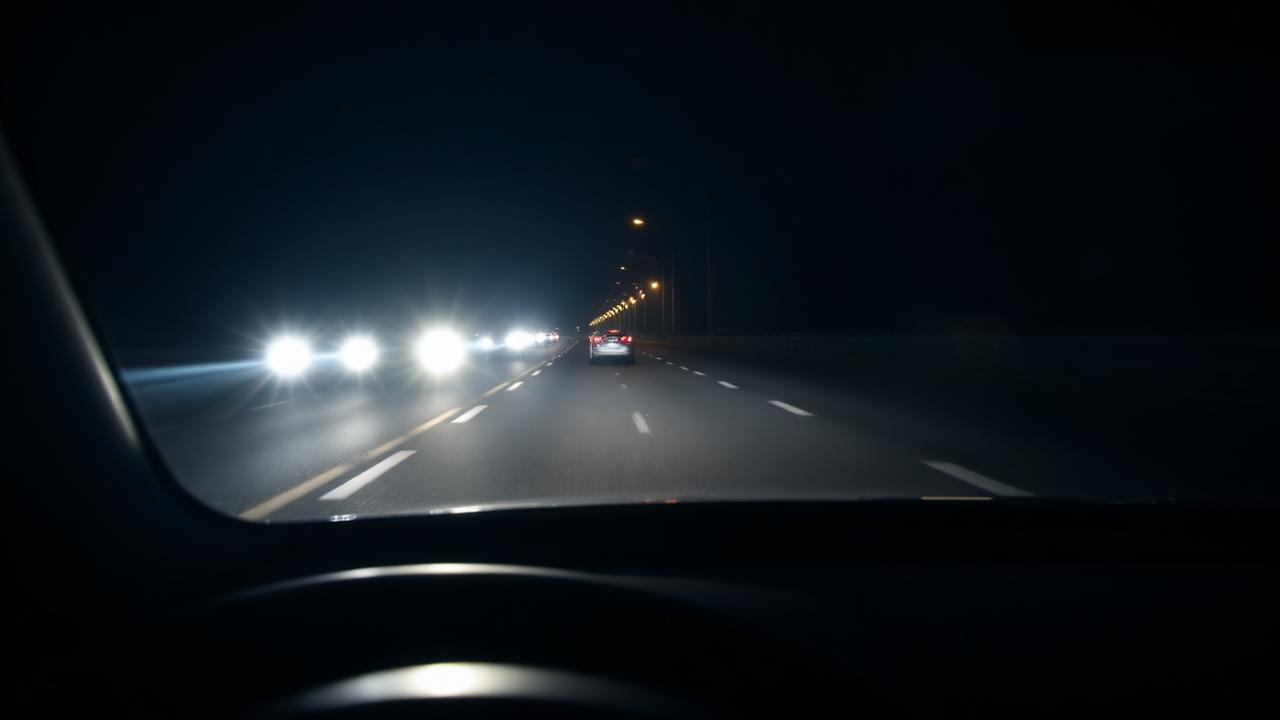
Seeing bright rings, starbursts or a scattered halo around headlights and streetlights at night is one of the earliest signals that something has changed in the optics of the eye. It is rarely dangerous but is often the first symptom that brings a UK patient to my clinic. This guide explains the main causes and what to do next.
Why halos happen
The eye focuses light through the cornea and lens onto the retina. Any imperfection along that path — a dry spot on the cornea, a clouded lens, an off-centre pupil, a laser-treatment zone — scatters some of the incoming light. Around bright point sources against a dark background (headlights on a wet road, streetlights, LED signs), that scatter is visible as halos, glare and starbursts.
The commonest causes
Early cataract. In UK adults over 55, the top cause is early cataract — the natural lens develops subtle opacities that scatter light. Halos are typically worst on wet roads at night. Vision by day may still be 6/6. See our what is a cataract guide.
Dry eye and blepharitis. An unstable tear film breaks up between blinks and scatters light. Halos come and go with each blink. Treatment of the underlying dry eye removes them completely.
After LASIK, PRK or SMILE. Around 3–6 months after refractive surgery, especially in patients with large pupils, some scatter around the treatment zone is normal. It usually settles by 6–12 months. Persistent halos may indicate residual refractive error and respond to enhancement.
After cataract surgery with a multifocal or EDOF lens. Multifocal lenses split light between distance and near foci, so a mild ring of light around headlights is a designed trade-off. Most patients adapt within 3–6 months. See our premium lens cataract surgery guide.
Angle-closure glaucoma — an emergency. Sudden severe halos with red painful eye, nausea, vomiting and blurred vision is angle-closure glaucoma. Attend eye casualty or A&E immediately.
High refractive error. Untreated short-sightedness or astigmatism causes glare and halos at night that resolve entirely with correct spectacles or contact lenses.
Migraine aura. Bright zigzag or coloured shapes lasting 20–30 minutes are migraine, not a lens problem.
When halos are urgent
See an eye specialist the same day if halos come with:
- Severe pain, redness or nausea (possible angle-closure glaucoma)
- Sudden loss of vision or a shadow across vision (possible retinal detachment)
- A haze over the whole eye and reduced daytime vision (possible corneal oedema)
How halos are investigated
In a night-vision-focused consultation I would typically:
- Measure vision at distance under standard and low-contrast conditions
- Check refraction — including small residual astigmatism
- Perform corneal topography and aberrometry
- Measure pupil size in scotopic (dim) conditions
- Examine the tear film and lens with a slit lamp
This identifies the cause in one visit and separates the treatable causes (cataract, dry eye, refractive error) from those that just need reassurance and time (post-refractive-surgery adaptation).
Next steps
If halos have started to affect your night driving, do not wait until you fail the DVLA standard — you can be assessed and treated privately within 2–4 weeks. Book a consultation or call 020 3137 3237 to have your night vision assessed.
Frequently asked questions
- Are halos a sign of cataract?
- They are one of the earliest signs in UK adults over 55, but dry eye and residual refractive error cause them too. A proper assessment tells you which.
- Can dry eye really cause halos?
- Yes — a thin or unstable tear film breaks up between blinks and scatters light. Treating the dry eye removes the halos.
- Do halos after LASIK ever go away?
- In most patients yes, within 6–12 months. Persistent halos may indicate residual refractive error and respond well to enhancement.
- When are halos an emergency?
- Sudden halos with severe pain, redness, nausea and blurred vision — that is angle-closure glaucoma. Attend eye casualty or A&E immediately.
Explore more on Eye Conditions
Related reading
Medical ophthalmology — consultant diagnosis & second opinions- My distance vision is good but I need glasses for reading — what should I do?
If your distance sight is still clear but reading is becoming a struggle, presbyopia is the most likely cause. Ms Tahmina Pearsall explains what to do next.
- Keratoconus explained: symptoms, diagnosis and modern treatment in the UK
A consultant guide to keratoconus — how the cornea thins and bulges, the earliest warning signs, and the modern treatments (cross-linking, ICRS, contact lenses and corneal grafts) that stabilise vision.
- Ptosis explained: why the upper eyelid droops and how it is treated
A consultant guide to ptosis — the causes of a drooping upper eyelid, when it needs investigation, and the modern surgical and non-surgical options available in the UK.
- Chalazion explained: the painless eyelid lump and how to treat it
A consultant guide to chalazion — why a firm painless lump forms on the eyelid, how it differs from a stye, and the warm compress, injection and minor surgery treatments that work.
Ready to discuss your options?
Book a private consultation with Ms Tahmina Pearsall, or call our secretary directly — mention this article and we'll pull up the treatment details for you.
Prefer to read first? 10 questions to ask your cataract surgeon
Boletín
Mantente al día sobre la salud de tus ojos
Recibe artículos expertos, novedades de la clínica y actualizaciones de tratamientos de la Dra. Tahmina Pearsall directamente en tu bandeja de entrada.