
Laser Eye Surgery
Riding glasses-free: why bikers struggle with specs — and how vision correction fixes it
Questions about your own eyes? Speak to Ms Pearsall's team — free, no obligation.
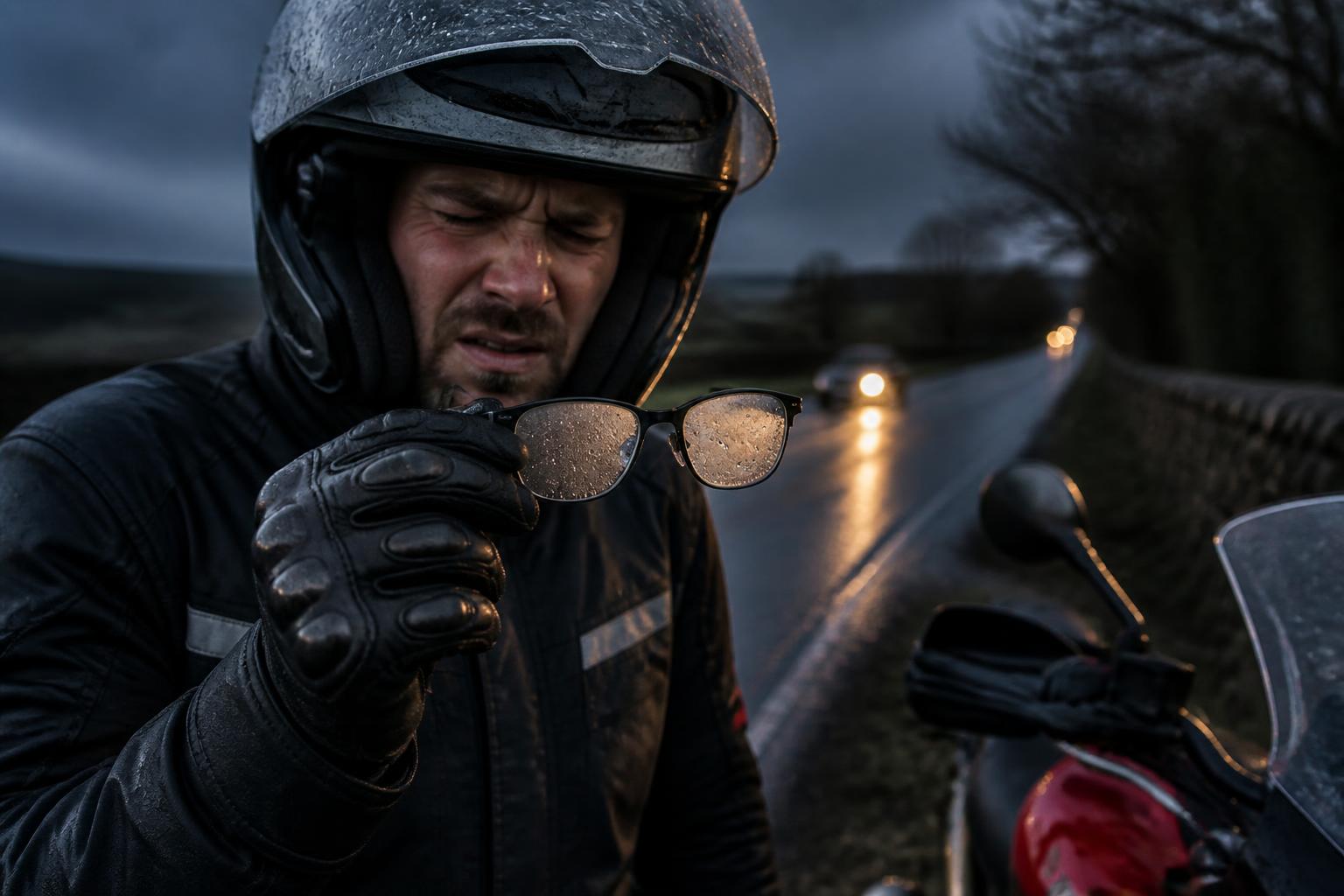
Ask any rider who wears prescription glasses and you will hear the same list: visor fog at the lights, rain sitting on the lenses, arms digging into your temples under a tight helmet, and that awkward two-handed shuffle to get specs on after the lid is already down. On a bike, vision is not a comfort issue — it is a safety system. Anything that degrades it degrades your stopping distance and your hazard perception.
This guide covers the technical reasons glasses underperform inside a helmet, what the UK legal vision standard actually requires, and how laser eye surgery or lens replacement with Ms Tahmina Pearsall, Consultant Ophthalmic Surgeon (FRCOphth), can remove the problem permanently. If you found us through the biker community, there is also a rider-focused overview on The Biker Guide's vision correction surgery page.
The legal baseline every rider has to meet
To hold a UK Group 1 licence — which covers motorcycles — you must be able to read a current-style number plate from 20 metres, with glasses or contact lenses if you need them, and you must have a visual acuity of at least 6/12 (0.5 decimal) using both eyes together. You also need an adequate field of vision. Meeting the minimum is not the same as riding well: 6/12 means you read a road sign at half the distance someone with 6/6 vision reads it. At 60 mph you cover roughly 27 metres every second, so a second of extra reading distance is real braking distance. Our Snellen chart and vision correction guide explains what each level of acuity means in practice.
Why glasses fail inside a helmet — the technical detail
Fogging is a dew-point problem, not a cleaning problem. Your breath leaves your body at around 34–35°C and close to 100% relative humidity. Inside the chin bar it hits a lens sitting at ambient temperature. On a 5°C morning, that warm, saturated air condenses instantly on the coldest surface it meets — usually your spectacle lens, because it sits behind the visor and away from the airflow that a Pinlock insert is designed to protect. Pinlock and anti-fog coatings protect the *visor*, not your glasses. That is why riders can have a crystal-clear visor and still be looking through a milky lens.
Rain and spray refract light unpredictably. Water droplets on a curved lens act as tiny lenses of their own, throwing point light sources — headlights, brake lights, wet cats' eyes — into smeared streaks. You cannot wipe spectacle lenses at speed, and behind a closed visor you cannot reach them at all.
Frame pressure and helmet fit. A correctly fitted helmet compresses the cheek pads and temple area. Spectacle arms sit exactly in that pressure zone, and after 60–90 minutes many riders get a pressure headache or numbness along the temple. Riders often size up a helmet to accommodate glasses, which increases helmet rotation in an impact — trading crash protection for visual comfort.
Reduced effective field of view. Frames introduce a physical blind edge and a prismatic 'jump' at the lens rim. Combined with the helmet aperture, this narrows the usable field precisely where a lifesaver shoulder check happens. Higher prescriptions and thicker lenses make the edge distortion worse.
Reflections and night glare. Even with anti-reflective coatings you now have four extra optical surfaces (two lens faces per eye) between your retina and the road, plus the visor. Each interface scatters oncoming headlight light. Add a scratched lens and you get veiling glare — the milky wash that hides an unlit pedestrian at the side of a country lane.
Sunglasses become a compromise. Prescription sunglasses, clip-ons, photochromic lenses or a tinted visor all lag behind real conditions. Photochromics react slowly and barely darken behind a UV-filtering visor, because the visor blocks the UV that triggers them. Emerging from a tunnel or tree cover into low winter sun is exactly when you least want a lens that is still catching up.
Contact lenses are not a clean fix either. Vented helmets create high tear-film evaporation. Riders regularly report lens dehydration, lens edge lift and blurring after 40–60 minutes at motorway speed, plus grit trapped under a lens on a dusty B-road — one of the more painful ways to end a ride.
What vision correction actually changes for a rider
Removing the lens from in front of the eye removes every one of the problems above at once: nothing to fog, nothing to rain on, nothing pressing on your temples, no frame edge in your lifesaver, and a full-aperture view through the visor. You also get to buy a helmet that fits your head rather than your glasses.
There are two routes, and the right one depends mostly on your age and the health of your natural lens.
Route 1 — Laser eye surgery (typically under 45)
LASIK, LASEK and SMILE reshape the cornea to correct short-sightedness, long-sightedness and astigmatism. For a rider with a stable prescription, healthy corneas and adequate corneal thickness, laser is usually the most direct answer. Modern wavefront-optimised and topography-guided treatments are designed to limit the induction of higher-order aberrations — the technical cause of night-time starbursts — and larger optical zones are used for riders with big scotopic (dark-adapted) pupils, which matters a great deal for night riding.
Screening is where safety is decided, not the laser. Ms Pearsall's assessment includes Pentacam corneal tomography to rule out keratoconus and forme fruste corneal weakness, pachymetry for corneal thickness, scotopic pupil measurement, tear-film and dry-eye assessment, and a full dilated retinal examination — short-sighted riders have a higher baseline risk of retinal tears, which is worth knowing about before you are 200 miles into a tour. Read more in how laser eye surgery works and is laser eye surgery safe?.
Typical timeline: LASIK vision is usable the next day; most riders are back on the bike for short local rides at around two weeks, with full touring from four to six weeks. LASEK and SMILE have slightly different recovery profiles and are discussed at consultation. See laser eye surgery costs in the UK.
Route 2 — Lens replacement / refractive lens exchange (typically 45+)
From the mid-forties the natural lens stiffens (presbyopia) and eventually clouds (cataract). No amount of corneal reshaping fixes that, and treating the cornea alone can leave you needing readers for the sat-nav and the fuel pump. Refractive lens exchange swaps the natural lens for an intraocular implant, correcting your distance prescription and pre-empting cataract — you will never develop one in a treated eye.
Lens choice is where a rider's brief differs from a desk worker's:
Monofocal (set for distance) — highest contrast sensitivity and the lowest rate of halos and starbursts. The best choice for high-mileage night riders and anyone who does dawn commutes or winter touring. Reading glasses are still needed for close work.
EDOF (extended depth of focus) — one continuous stretch of vision from distance through the instrument cluster, with far fewer night-time optical side effects than a full multifocal. For most riders who want the dash and the road sharp without readers, this is the sweet spot.
Trifocal / multifocal — the most spectacle independence, including a phone and a map at a fuel stop, but it splits incoming light between focal points. That reduces contrast slightly and increases halos around oncoming headlights, particularly in the first three to six months of neuroadaptation. Suitable for lower-mileage and mostly daylight riders.
Toric versions of all of the above correct astigmatism, which is common and is one of the biggest causes of headlight flare at night if left untreated.
The honest conversation about halos matters more for bikers than almost any other patient group, because you are unprotected, often riding at dusk, and reading a road surface for diesel and potholes. Ms Pearsall will not fit a trifocal to a rider whose riding profile argues against it. More detail: premium lens cataract surgery and lens replacement costs in the UK.
Night riding, contrast and the technical bit riders care about
Two measurements predict how happy you will be at night: your scotopic pupil size and your induced higher-order aberrations. A large dark-adapted pupil that exceeds the treated optical zone lets unfocused peripheral light spill onto the retina, which is perceived as glare or a starburst. Ms Pearsall measures pupil size in the dark as standard and sizes the treatment zone accordingly, or steers you towards a lens-based solution if the numbers do not support laser. Contrast sensitivity — the ability to distinguish a grey object against a grey background, which is exactly what a wet unlit lane is — is also assessed, not just the letter chart.
Riding after surgery: a realistic schedule
Day 0–1: day-case procedure under local anaesthetic with light sedation. No riding. Someone else takes you home.
Day 1: post-operative check. Vision usually functional; drops start.
Week 1: no helmet if possible — the last thing you want is a chin strap or a tight lid near a healing eye. Avoid dust, wind and pressure.
Week 2: most riders are cleared for gentle, short daylight rides once the surgeon confirms healing. Full protective kit, clean visor, no track days.
Weeks 4–6: touring, longer distances and night riding, provided contrast and healing are confirmed at review.
Your exact timeline is set at your review appointments, not by a generic chart. You must also confirm you meet the DVLA standard before riding — after successful surgery, most riders exceed it comfortably.
Why bikers choose Ms Tahmina Pearsall
Ms Pearsall is a Fellow of the Royal College of Ophthalmologists and an NHS Consultant Ophthalmic Surgeon who has performed over 40,000 intraocular procedures. Riders specifically benefit from:
Consultant-delivered care. Ms Pearsall performs your assessment, your surgery and your follow-up personally — you are not passed between a screening optometrist and an unknown surgeon on the day.
Lifestyle-matched lens selection. Your annual mileage, how much you ride at night, whether you tour, commute or do track days, and whether you need to read a map or a GoPro screen all feed into the recommendation.
Full diagnostic workup, including corneal tomography, scotopic pupillometry, tear-film assessment and dilated retinal examination — not a 20-minute suitability check.
Honest triage. If your corneas or your riding profile mean laser is the wrong answer, you will be told so, and if surgery is not right for you at all you will be told that too.
Clinics across the UK, including Harley Street London, Southampton, Belfast, Birmingham and East Surrey — see all locations.
A written, all-inclusive quote covering consultation, scans, surgery, lens, medication and post-operative reviews. No surprises.
Book your rider consultation
If you are tired of choosing between a helmet that fits and a lens you can see through, book a consultation with Ms Tahmina Pearsall. You will get a full diagnostic assessment, a straight answer on whether laser or lens replacement suits your eyes and your riding, and a written quote before you commit to anything.
Book a consultation or read more about laser eye surgery and lens replacement surgery. Riders who came via the biker community can also read the overview on The Biker Guide.
Frequently asked questions
- Why do my glasses fog up inside my helmet even with a Pinlock visor?
- A Pinlock insert protects the visor, not your spectacle lenses. Your breath leaves your body warm and almost fully saturated with moisture, and it condenses on the coldest surface it reaches — which is usually your glasses, sitting behind the visor and out of the airflow. Removing the glasses altogether is the only complete fix.
- Can I ride a motorbike after laser eye surgery or lens replacement?
- Most riders avoid wearing a helmet for the first week, return to gentle short daylight rides at around two weeks once healing is confirmed, and resume touring and night riding at four to six weeks. Your surgeon confirms the timeline at your review appointments.
- Will I get halos around headlights at night after surgery?
- It depends on the treatment. Monofocal lenses and well-planned laser treatments give the highest contrast and fewest halos, which is why they suit high-mileage night riders. Trifocal lenses split light between focal points and can cause halos, especially in the first three to six months. Ms Pearsall measures your dark-adapted pupil size and matches the treatment to how much you ride at night.
- What vision do I legally need to ride a motorcycle in the UK?
- For a Group 1 licence you must read a current-style number plate at 20 metres, with correction if needed, and have at least 6/12 visual acuity with both eyes open, plus an adequate visual field. Successful vision correction normally takes riders well past that minimum.
- Is laser or lens replacement better for a motorcyclist?
- Under about 45 with a stable prescription and healthy corneas, laser eye surgery is usually the most direct option. From the mid-forties, lens replacement is generally better because it also addresses reading vision and removes any future cataract. The decision is made on scans, not age alone.
- How much does it cost for riders?
- Laser eye surgery starts from around £2,400 per eye. Lens replacement starts from around £2,750 per eye for a monofocal lens and around £4,200 per eye for a premium EDOF, multifocal or trifocal lens. Every quote is all-inclusive and provided in writing at consultation.
Explore more on Laser Eye Surgery
Related reading
- Is laser eye surgery safe? A UK consultant's honest guide to risks, side effects and long-term results
A frank UK consultant guide to the safety of LASIK, LASEK, SMILE and Presbyond — the real risks, dry-eye rates, night-vision effects, and how a strict pre-op screening protocol keeps serious complications below 1 in 1,000.
- How laser eye surgery works: LASIK, LASEK, SMILE and Presbyond explained by a UK consultant
A step-by-step consultant's guide to how modern laser eye surgery actually reshapes your cornea — the physics of the excimer laser, the difference between LASIK, LASEK, SMILE and Presbyond, and what happens minute-by-minute on the day.
Ready to discuss your options?
Book a private consultation with Ms Tahmina Pearsall, or call our secretary directly — mention this article and we'll pull up the treatment details for you.
Prefer to read first? 10 questions to ask your cataract surgeon
Newsletter
Bleiben Sie über Ihre Augengesundheit informiert
Erhalten Sie Fachartikel, Klinik-News und Behandlungsupdates von Dr Tahmina Pearsall — direkt in Ihr Postfach.