
Vision Correction
Snellen chart and vision correction: what 6/6, 6/12, 6/60 and 20/200 actually mean
Questions about your own eyes? Speak to Ms Pearsall's team — free, no obligation.
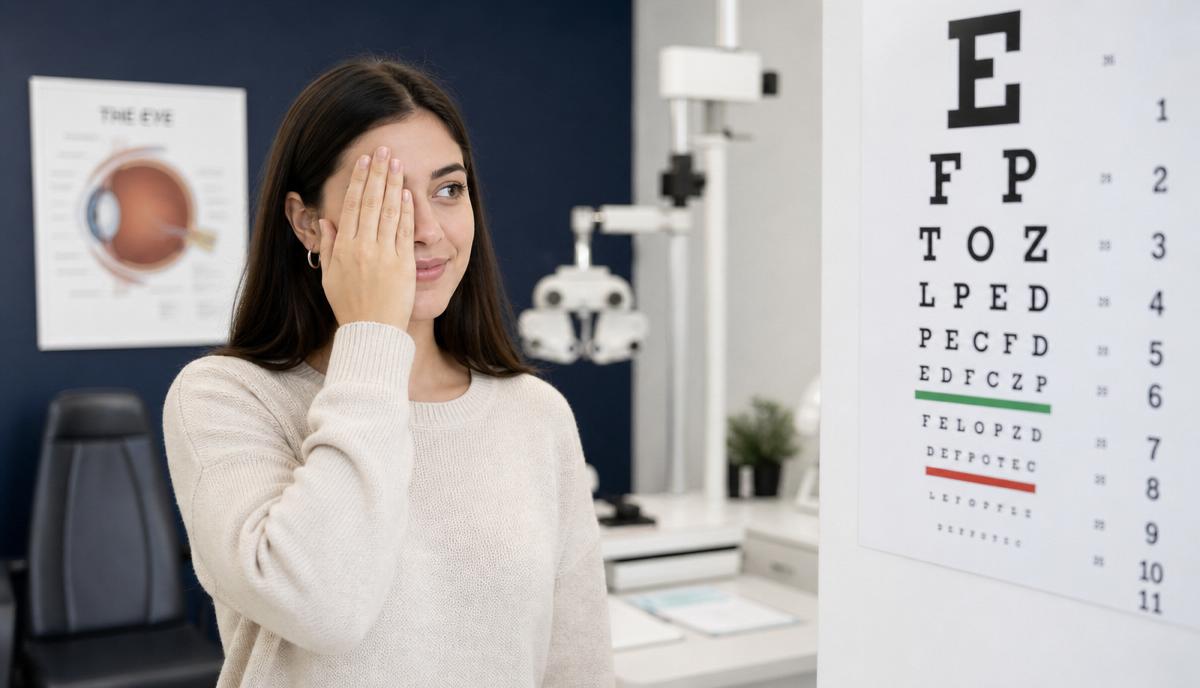
The Snellen chart — the familiar wall chart of shrinking black letters — was invented by Dutch ophthalmologist Hermann Snellen in 1862 and remains the international standard for measuring visual acuity. The two numbers written on your prescription (6/6, 6/12, 6/60 in metric UK notation, or 20/20, 20/40, 20/200 in imperial US notation) describe how well you can see fine detail at distance. Understanding what those numbers actually mean helps you make informed decisions about glasses, laser eye surgery, lens replacement surgery and low-vision support.
This guide explains every step of the Snellen ladder, what each level looks like in daily life, and — critically — which vision-correction options can bring you back up the chart. If you would like your own vision assessed by a UK consultant, you can book a free 15-minute call or read our overviews of laser eye surgery and lens replacement surgery.
How to read Snellen notation
In UK notation, the top number is the testing distance in metres (almost always 6 metres, which is optically equivalent to infinity). The bottom number is the distance at which a person with normal vision can read the same line. So 6/12 vision means that what a normally sighted person can read at 12 metres, you can only read at 6 metres. In US notation the distance is 20 feet, so 6/6 = 20/20 and 6/60 = 20/200 — they describe identical vision.
6/6 (20/20) — 'normal' vision
6/6 vision is the reference line, not perfection. Around 35% of adults naturally see slightly better than 6/6 (often 6/5 or 6/4). At 6/6 you can read a car number plate at 20 metres, follow subtitles comfortably, and pass the UK driving eyesight test without difficulty. Correction needed: none for distance if achieved unaided; reading glasses may still be needed after age 45 (presbyopia).
6/9 (20/30) — very mild reduction
You can still drive legally in the UK (the standard requires 6/12 or better with glasses, plus reading a number plate at 20 m). Fine text on distant signs may look slightly softer. Correction: usually resolved by a mild prescription, LASIK, SMILE, LASEK or Presbyond in the right candidate — see how laser eye surgery works.
6/12 (20/40) — the UK legal driving threshold
6/12 is the minimum standard for a UK driving licence when tested with glasses or contact lenses. Below this level you cannot legally drive. You can still watch television and read a book comfortably, but street signs and menus at a distance are blurred. Correction: glasses, contact lenses, or laser eye surgery are the usual routes back to 6/6. If early cataract is present, lens replacement surgery may be recommended.
6/18 (20/60) — moderate visual impairment
You struggle to read shop signs across the street, and driving is not legal. Reading is still possible with larger print or magnification. Common causes are refractive error left uncorrected, moderate cataract or early macular disease. Correction depends on the cause: an up-to-date refraction and full eye examination is the first step. If a cataract is present, cataract surgery with a premium lens can often restore 6/6 or better.
6/36 (20/120) — significant impairment
Faces are recognisable only at a few metres. Standard-print reading is not possible without strong magnification. Almost always caused by a treatable pathology in the UK — most often cataract, but also refractive error, macular disease, glaucoma or diabetic retinopathy. Correction: a full ophthalmology assessment is essential. Many patients regain 6/6 vision after cataract surgery, refractive lens exchange or laser treatment. Ms Pearsall's team routinely reviews second opinions at this level — you can book a consultation.
6/60 (20/200) — the UK 'severely sight impaired' threshold
6/60 or worse in the better eye, with best correction, is the threshold for certification as severely sight impaired (blind) in the UK — the legal definition of blindness. You can see the top letter of a Snellen chart at 6 metres; a normally sighted person could read that letter from 60 metres away. Faces are only recognisable at arm's length. Can 6/60 vision be corrected? It depends entirely on the cause. If the underlying pathology is a dense cataract, meaningful vision improvement after cataract surgery is common. If it is caused by advanced age-related macular degeneration, advanced glaucoma, optic-nerve disease or long-standing retinal disease, the retina or optic nerve may not be able to send a normal signal to the brain, and even a perfectly clear optical system will not restore 6/6. Low-vision aids, magnification, screen-reading technology and CVI (Certificate of Vision Impairment) registration then become the priority.
3/60 and worse — 'blindness' in the strict sense
Below 3/60 vision (counting fingers, hand movements, light perception) is what most people picture when they hear the word 'blind'. Causes are usually advanced retinal or optic-nerve disease. Vision-correction surgery cannot help at this level, but early diagnosis and treatment of the underlying condition — particularly glaucoma — is often what determines whether patients ever reach this stage.
Which correction option applies at your level?
Refractive error only (short-sightedness, long-sightedness, astigmatism): glasses, contact lenses, or laser refractive surgery (LASIK, LASEK, SMILE, Presbyond) will typically restore 6/6.
Refractive error plus age >45 with early lens changes: lens replacement surgery (also called refractive lens exchange) removes the ageing natural lens and replaces it with a premium multifocal or extended-depth-of-focus lens.
Cataract: cataract surgery, including complex cataract surgery or premium lens cataract surgery — usually the single most effective vision-restoration procedure in medicine.
Glaucoma, macular disease, retinal disease, optic-nerve disease: treatment focuses on preserving remaining vision. See glaucoma and eye conditions, or book a consultation for a specialist opinion.
The DVLA / UK driving standard in one line
You must be able to read a UK number plate at 20 metres (with glasses/contacts if worn), and achieve a visual acuity of at least 6/12 (0.5 decimal / 20/40) with both eyes open, with a horizontal visual field of at least 120°. If your vision drops below these standards, you are legally required to inform the DVLA.
Related reading: is laser eye surgery safe?, how laser eye surgery works, laser eye surgery, lens replacement surgery, full eye service list, consultant ophthalmologist, glaucoma and our condition guides for keratoconus, ptosis, chalazion and xanthelasma.
To find out what is causing your reduced vision and which correction options apply to you, book a free 15-minute call with a UK consultant or request a full consultation.
Frequently asked questions
- What does 6/6 vision actually mean?
- 6/6 (or 20/20 in US notation) is the international reference standard for 'normal' distance vision. It means that at 6 metres you can read the line on a Snellen chart that a person with normal vision can also read at 6 metres. It is not perfection — around 35% of adults naturally see slightly better than 6/6.
- Can 6/60 or 20/200 vision be corrected?
- It depends entirely on the cause. If the underlying problem is a dense cataract, severe refractive error, or a corneal condition, cataract surgery, lens replacement or laser surgery can often restore 6/6 vision. If the reduction is caused by advanced macular degeneration, glaucoma, or optic-nerve disease, the retina cannot transmit a full-detail image and vision cannot usually be restored — low-vision aids and CVI registration then become the priority.
- What is the UK legal driving vision standard?
- You must be able to read a UK vehicle number plate at 20 metres (with glasses or contact lenses if worn), achieve a visual acuity of at least 6/12 with both eyes open, and have a horizontal field of vision of at least 120°. You are legally obliged to inform the DVLA if your vision falls below these standards.
- What counts as legally blind in the UK?
- In the UK, 'severely sight impaired' (the legal definition of blindness) applies when best-corrected vision in the better eye is 6/60 or worse, or 3/60–6/60 with a very restricted visual field. 'Sight impaired' (partially sighted) applies at 6/24 to 6/60 with a full field. Certification requires a Certificate of Vision Impairment (CVI) issued by a consultant ophthalmologist.
- Is 20/20 the same as 6/6?
- Yes — they are identical. 20/20 is the US notation using feet (20 feet ≈ 6 metres); 6/6 is the UK/European notation using metres. Both describe the same 'normal' level of distance vision.
Ready to discuss your options?
Book a private consultation with Ms Tahmina Pearsall, or call our secretary directly — mention this article and we'll pull up the treatment details for you.
Prefer to read first? 10 questions to ask your cataract surgeon
Newsletter
Restez informé sur la santé de vos yeux
Recevez articles d'expertise, actualités des cliniques et nouveautés en traitement de la part du Dr Tahmina Pearsall — directement dans votre boîte de réception.